Community


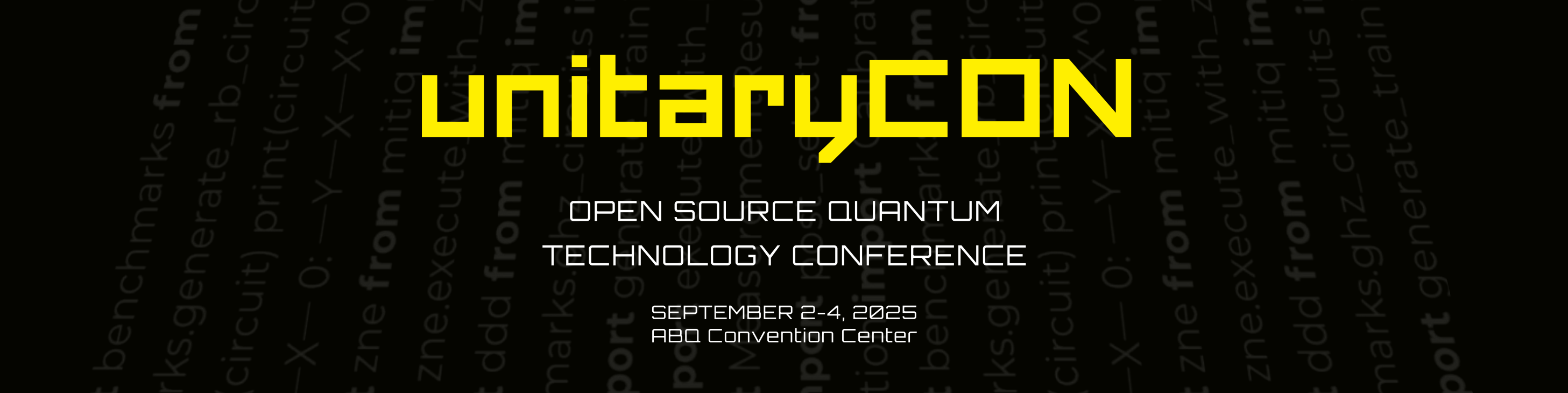
unitaryCON - Open Source Quantum Technology Conference
🗓️ September 2-4, 2025 | 📍 ABQ Convention Center 401 2nd St NW, Albuquerque, NM 87102
Are you an IEEE attendee who’d like to join us for unitaryCON? RSVP through this link. We’re excited to see you there!
unitaryCON is an annual, collaborative workshop for the extended Unitary Foundation community. The workshop is an opportunity to share ongoing projects, connect with collaborators and supporters, and work with our community to advance the quantum open-source software ecosystem with the leading contributors from around the world.
Hosted at IEEE Quantum Week 2025, unitaryCON will provide a unique opportunity for Unitary Foundation advisors, grantees, staff, ambassadors and friends to gather, talk, learn, and share ideas about how to move the field forward.
The workshop will feature talks and interactive activities, revolving around various topics in open source software for quantum computing and quantum technologies, including compilers, error mitigation and error correction toolkits, platforms for quantum computing, SDKs, cloud platforms, and open hardware in quantum tech.
For information on the unitaryCON code of conduct, please visit our GitHub.
Schedule overview
Welcome Mixer from 6:00pm to 8:00pm
| TIME | SESSION |
|---|---|
| 12:00–12:30 | Check in and networking |
| 12:30–1:00 | Intro Talks by UF staff and guest speakers |
| 1:00–2:15 | Featured Speakers |
| 2:15–3:15 | Co-Coding / Breakout Sessions |
| 3:15–3:30 | BREAK |
| 3:30–4:30 | Lightning Talks |
| 4:30 and on | Open Networking Time |
| TIME | SESSION |
|---|---|
| 12:00–12:30 | Check in and networking |
| 12:30–1:45 | Unconference Sessions (Pt. 1) |
| 1:45–2:00 | BREAK |
| 2:00–3:15 | Unconference Sessions (Pt. 2) |
| 3:30–5:00 | Group Trip to Local Quantum Research Space |
Program Details
Intro Talks
Speakers:
Will Zeng and Veena Vijayakumar from Unitary Foundation
Robert Ledoux and Ivan Deutsch from the University of New Mexico
Jake Douglass from Sandia National Laboratories.
Featured Speakers
From Benchmarks to Verification: Strengthening Quantum Software with the MQT
Speaker: Lukas Burgholzer — TUM & MQSC
Abstract: In this talk, I will briefly introduce the MQT (Munich Quantum Toolkit) and highlight recent developments in MQT Bench, our open-source framework for
benchmarking quantum computing software and tools. With the release of a major new version, MQT Bench now supports a broader range of algorithms, backends, and
compilation options, making it a versatile tool for both researchers and practitioners. Beyond benchmarking, I will also discuss our work on equivalence checking and verification, a critical component for ensuring the correctness of quantum programs. These techniques are especially relevant in the context of quantum compiler development and optimization to ensure the correctness of the transformations. The session will conclude with an open discussion round, inviting participants to share ideas, challenges, and potential collaborations around open-source quantum software tooling.
How to run QEC experiments with Deltakit
Speaker: Tom Hartley — Riverlane
Abstract: Deltakit is a Python library for QEC researchers that makes it easy to run QEC experiments in simulation and real hardware using Stim. Deltakit is based on internal tools at Riverlane, built by our quantum science and engineering teams, and used for QEC research with our customers and partners in the past 5 years. In this 15-minute feature talk, I’ll show you how to use Deltakit to pick an error corrected code, QPU-specific native gates, noise model (gate noise, bit, and phase flips), and generate a Stim circuit that you can then simulate and use a decoder to assess your logical error rate. During the breakout session, we’ll have a hands-on workshop where you can try out Deltakit and use it with various decoders, both open source and Riverlane proprietary decoders available via the Cloud. To prepare for the workshop, please register for the Private Beta at https://bit.ly/44UizNR
The qBraid-SDK: A Platform-Agnostic Approach to Building Quantum Runtime Frameworks
Speaker: Ryan Hill — qBraid
Abstract: As quantum computing platforms continue to grow in number and capability, standardization and accessibility remain formidable challenges. While industry leaders have created powerful quantum software development kits, these primarily align with their parent company’s hardware or cloud service. The qBraid-SDK is an open-source, platform-agnostic quantum runtime framework that aims to provide a standard way to communicate with quantum resources. Most notably, it does not adhere to a fixed circuit-building library, or quantum program representation, and supports a “bring your own cloud” model, allowing providers to target any API endpoint that satisfies a few minimal requirements. By addressing the full scope of client-side software requirements necessary for submission and management of quantum jobs, the qBraid-SDK vastly reduces the overhead and redundancy typically associated with the development of internal pipelines and cross-platform integrations in quantum computing, thus empowering the quantum community to innovate, collaborate, and scale more efficiently.
Bloqade: SDK for Programming Neutral Atom Quantum Computer
Speaker: Kai-Hsin Wu — QuEra
Abstract: In this talk, we will introduce Bloqade, an open-source Python SDK designed for programming neutral atom quantum computers. Built atop Kirin, QuEra’s open-source, scientist-first compiler toolchain, Bloqade provides a set of embedded domain-specific languages (eDSLs) that let users express quantum programs from high-level circuit descriptions down to atom-level control with flow and shuttling. Bloqade is purpose-built to harness the power of QuEra’s transversal gate architecture, enabling natural expression of parallel quantum operations. With support for quantum intermediate representations such as OpenQASM and Stim, Bloqade also integrates seamlessly with existing quantum toolchains. Together, Bloqade and Kirin offer a complete workflow—from algorithm design to simulation to hardware execution—empowering users to explore new abstractions, compilation strategies, and quantum algorithms optimized for neutral atom hardware.
State of the Qubit in Qiskit — Your yearly dose of “everything you need to know about Qiskit direction” in one talk
Speaker: Luciano Bello — IBM
Abstract: Qiskit has entered the 2.x era, bringing a faster, sturdier and more flexible foundation for quantum programming. New ingredients such as a C API layer, Rust components, and speedups in circuit building and transpilation are reshaping how quantum code is developed. Enhanced circuit features are opening new possibilities for next generation hardware. The 2.x cycle is also about people, with the relaunch of the Qiskit Advocate program to empower the community and the return of the Qiskit Developer Certification to help developers showcase their skills.
This session is your annual “state of the qubit in Qiskit” update, offering roadmap highlights, community news and a glimpse of the quantum future. We will have an AMA, so bring your questions and comments.
Lightning Talk Speakers
ZXLive: drag-and-drop to draw and apply ZX-calculus
Speaker: Lia Yeh
Abstract: This talk is about the open-source quantum software library ZXLive. ZXLive is a Graphical User Interface to draw and apply rules in the ZX-calculus by just drag and drop, click of a button, or wave of the magic wand tool - no coding required. It builds on top of PyZX, an open-source Python library for the ZX-calculus, a Unitary Foundation funded microgrant project. ZXLive has been used by students to do their programming homeworks and projects in the Quantum Software graduate course at the University of Oxford, and has been developed through a number of semi-annual small hackathon sessions amongst students and early-career researchers.
The Quantum Compilation hub: centralizing the scattered knowledge on quantum compilation
Speaker: Catalina Albornoz
Abstract: The Quantum Compilation hub is a community-driven and software-agnostic project designed to consolidate the scattered knowledge on quantum compilation. Our goal is to create a centralized, easily searchable database of quantum compilation passes, methods, IRs, and software implementations from the open-source ecosystem. This year we’ve been working on a foundational schema and a minimum viable product (MVP), successfully cataloging initial passes and techniques. Now we’re ready to bring the community in.
CCMap: Lightweight Compiler Integration for Chiplet-Based Modular Quantum Systems
Speaker: Zefan Du
Abstract: As superconducting quantum processors scale, monolithic architectures face manufacturing and control bottlenecks. Modular systems, composed of smaller quantum chips interconnected via short-range couplers, offer a promising alternative. These couplers enable direct two-qubit gates across chips but impose constraints, fixed, sparse connectivity, and unique control protocols, which invalidate compilation strategies designed for NISQ-era monolithic devices. Unlike distributed quantum frameworks relying on teleportation, chiplet-based systems support native cross-chip operations, creating new challenges for circuit compilation.
We present CCMap, a lightweight, hardware-aware framework for compiling circuits on coupler-connected modular superconducting systems. CCMap partitions the input circuit into subcircuits, compiles each with an external compiler (e.g., UCC) for optimized intra-chip mapping, then explicitly models and refines inter-chip operations. This iterative process minimizes both inter-chip and intra-chip overhead while preserving high fidelity.
Evaluations on IBM-inspired chiplet topologies show that CCMap reduces SWAP counts and inter-chip operations by up to 58.6%, improving estimated circuit fidelity by over 20% compared to baseline methods. Integrated with UCC, CCMap achieves state-of-the-art reductions in SWAP gate overhead and cross-chip costs.
By addressing the unique constraints of coupler-connected modular architectures, CCMap bridges the gap between emerging hardware and existing compiler infrastructures. This enables researchers and practitioners to leverage current software tools to fully exploit chip-based architectures.
This talk will introduce CCMap’s motivation, design, and integration flow, highlight experimental results, and discuss implications for near-term modular quantum computing.
Quantum Optimization Benchmarking Library — The Intractable Decathlon
Speaker: Christa Zoufal
Abstract: Quantum computers have advanced to the point where benchmarking of quantum algorithms at scale is within reach. Particularly in combinatorial optimization — where most algorithms are heuristics — it is key to empirically analyze their performance on hardware and track progress towards quantum advantage. To this extent, we present ten optimization problem classes that are difficult for existing classical algorithms and can (mostly) be linked to practically-relevant applications, with the goal to enable systematic, fair, and comparable benchmarks for quantum optimization methods. Further, we introduce the Quantum Optimization Benchmark Library (QOBLIB) where the problem instances and solution track records can be found. The individual properties of the problem classes vary in terms of objective and variable type, coefficient ranges, and density. Crucially, they all become challenging for established classical methods already at system sizes ranging from less than 100 to, at most, an order of 100,000 decision variables, allowing to approach them with today’s quantum computers. We reference the results from state-of-the-art solvers for instances from all problem classes and demonstrate exemplary baseline results obtained with quantum solvers for selected problems. The baseline results illustrate a standardized form to present benchmarking solutions, which has been designed to ensure comparability of the used methods, reproducibility of the respective results, and trackability of algorithmic and hardware improvements over time. We encourage the optimization community to explore the performance of available classical or quantum algorithms and hardware platforms with the benchmarking problem instances presented in this work toward demonstrating quantum advantage in optimization. See arxiv paper.
Intrinsic error mitigation in quantum-classical auxiliary-field quantum Monte Carlo
Speaker: Tim Chen
Abstract: Quantum-classical auxiliary-field quantum Monte Carlo (QC-AFQMC) is a hybrid algorithm for ground state problems in quantum chemistry. We experimentally demonstrate a formally efficient AFQMC process through the adoption of matchgate shadows. The algorithm does not require optimization loops like VQE and it exhibits a built-in error mitigation that makes it resilient to noise. Through algorithmic improvements and the usage of state-of-the-art GPUs, the computational time of classical post-processing is reduced by several orders of magnitude. See arxiv paper.
OrangeQS Juice: an open-source OS powering Quantum Experiments and Innovation
Speaker: Marlo Kuerner
Abstract: OrangeQS Juice is a Linux-based open-source operating system specifically engineered for quantum R&D systems. Its development arose from the critical need for unified control and improved operability of quantum R&D systems within a single framework. This led to our vision for Juice: to build a robust, efficient, and open platform that facilitates and accelerates quantum Research and Development.
pypiccolo, a novel julia-based python package for robotics-inspired quantum optimal control
Speaker: Aaron Trowbridge and Gennadi Ryan
Abstract: Piccolo.jl is a rapidly growing toolbox for state-of-the-art quantum pulse optimization. Porting this codebase to python---the language most quantum researchers use---is a critically important task. Extant tools for this come with certain disadvantages, in particular, annoyingly long run-time precompilation, that we have devised an approach to overcome. This talk will focus on the challenges and solutions developed to make Julia a usable backend language for python utilization.
Some progress on QIR-EE: A Cross-Platform Execution Engine for QIR
Speaker: Elaine Wong
Abstract: Progress and some quick updates on the execution engine for the Quantum Intermediate Representation (QIR-EE) and how we are viewing its integration into the QC-HPC ecosystem.
Quantum Advantage for Nonlinear Optimization: Theory and Open-Source Software
Speaker: Jiaqi Leng
Abstract: We develop an open-source, end-to-end software (named QHDOPT), which can solve nonlinear optimization problems using the quantum Hamiltonian descent (QHD) algorithm. QHDOPT offers an accessible interface and automatically maps tasks to various supported quantum backends (i.e., quantum hardware machines). These features enable users, even those without prior knowledge or experience in quantum computing, to utilize the power of existing quantum devices for nonlinear and nonconvex optimization tasks. In its intermediate compilation layer, QHDOPT employs SimuQ, an efficient interface for Hamiltonian-oriented programming, to facilitate multiple algorithmic specifications and ensure compatible cross-hardware deployment. The detailed documentation of QHDOPT is available at https://github.com/jiaqileng/QHDOPT.
OpenQudit: Extensible and Accelerated Numerical Quantum Compilation by JIT-Compiling a Qudit Gate DSL
Speaker: Ed Younis
Abstract: Quantum gates are the fundamental instructions of digital quantum computers. Current programming languages, systems, and software development toolkits identify these operational gates by their titles, which requires a shared understanding of their meanings. However, in the continuously developing software ecosystem surrounding quantum computing—spanning high-level programming systems to low-level control stacks—this identification process is often error-prone, challenging to debug, maintenance-heavy, and resistant to change. In this talk, we introduce unitary expressions, a form of accelerated symbolic computation, that aims to shift this burden of identification away from gate labels.
Unconference Session Topics + Group Leads
Part 1
Part 2
Other event details
You can stay up to date with the information on unitaryCON on the unitarycon channel on the Unitary Foundation Discord.
All participants must adhere to Unitary Foundation’s Community Code of Conduct.
unitaryCON Supporters
Thank you to our members and event sponsors for making unitaryCON possible!


IBM Quantum, DoraHacks, Open Quantum Design
AWS, Microsoft, QC Ware, Quantum Machines, Riverlane, SandboxAQ
unitaryCON is co-located with IEEE Quantum Week 2025
EVENT ORGANIZERS
Veena Vijayakumar, Co-Director Changhao Li, Co-Director and the Unitary Foundation Team